

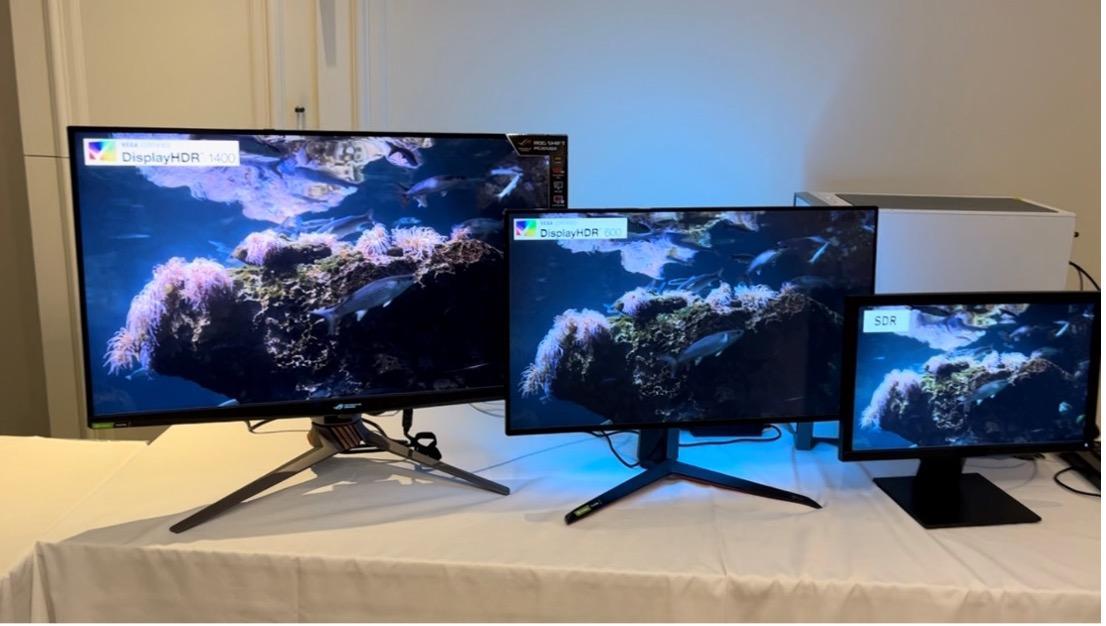
VESA DisplayHDR certification was introduced for differentiating HDR performances; but these metrics are often misunderstood by many users. While this certification is still very much active in visual systems, it is no longer a sole indicator of HDR performance, especially in new-gen displays.
Due to the advancement in HDR implementations, the quality of modern monitors cannot be quantified by what certification levels suggest. And even though most labels display HDR support on monitors and PCs, they do not deliver the same visual experience. There are differences in color, brightness, local dimming, and even response time.
Unfortunately, these differences aren’t easy to catch when selecting HDR displays, leaving too many users with unexpected underwhelming image quality. In this guide, we will discuss various VESA DisplayHDR certification levels to help you make informed choices when selecting HDR visual system.

Image credit: VESA Certified
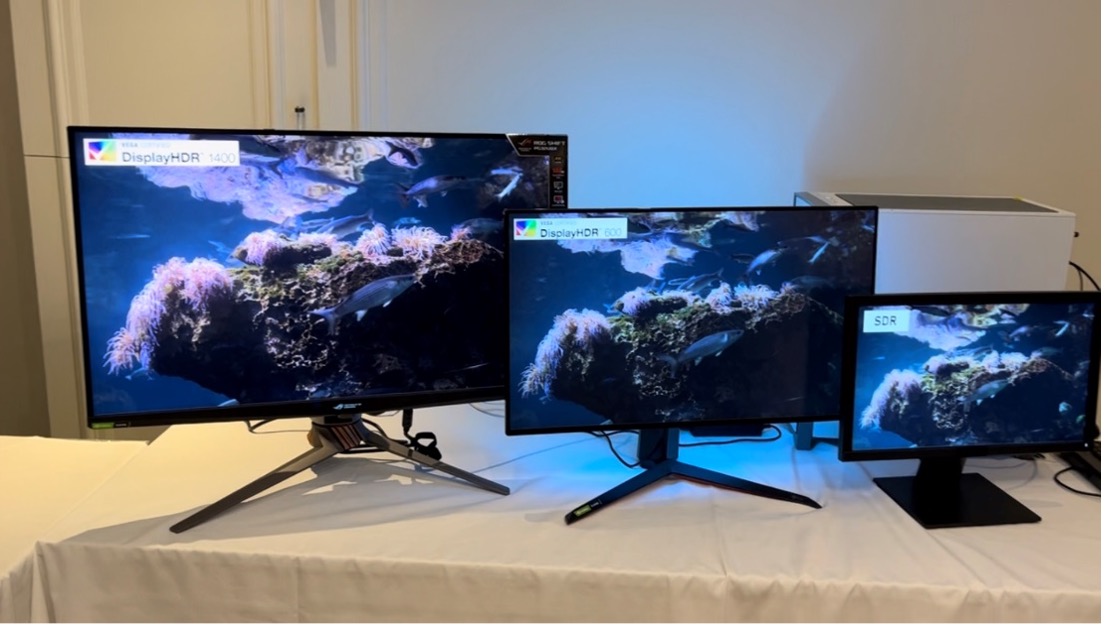
What Is VESA DisplayHDR Certification?
VESA is a company that introduced advanced specifications used for certified HDR visual systems. These certification standards need to be met as they ensure that every display meets a specific level of quality. Even though there are lower-level tiers, this certification gives you a full detail of which visual systems are decent enough in HDR with high performance.
While the VESA standard has long been in the business of evaluating visual outputs, the evolution of recent computers have pushed the industry towards better display. It was only a matter of time before VESA re-introduced the DisplayHDR as a unified way to define HDR capable displays. The DisplayHDR is simply a compliance test for screen specifications, where you can rate your visual systems based on the HDR scale.
This brings us to the sole difference between “HDR support” and “DisplayHDR certification.” On one hand, a visual system with the “HDR support” tag often possesses the qualities required to pick a high dynamic range signal. Even though they display HDR quality, this doesn’t guarantee meaningful visual experience as seen in recent computers.
On the other hand, DisplayHDR certification is a guarantee that your display panels have passed specific VESA testing criteria. These tests ensure that your imaging interface meets up with a level of brightness and color depths for premium HDR performance. Unlike HDR support, this standard defines minimum performance requirements. However, this is not a promise of the highest possible image quality.
Why Is DisplayHDR A Necessity for Monitors?
Before the invention of DisplayHDR, too many visual systems got away with poorly unregulated HDR performances. With the “HDR support” tag, many products were considered high performance even after failing to display HDR content at a high level.
The primary limitation of many so-called HDR-capable systems was inadequate brightness performance. To make matters worse, many applications at that time applied HDR mapping inconsistently, further degrading image quality.
Hence, DisplayHDR was introduced as a standard way of comparing HDR monitors by referencing a defined certification level. This certification analyzes the visual quality of monitors using certain core metrics that is tantamount to a meaningful HDR experience. Here are some key performance areas covered by DisplayHDR;
- Peak Luminance
This is one of the most important HDR factors that involves evaluations of the maximum brightness in a visual system. Peak luminance is determined by the highest brightness the panel can produce in a limited area.
- Black Level
The black level measures how deep a monitor can display deep black colors in contrast to bright white areas at the same time. This is why visual panels are more equipped with advanced dimming technology in higher certification levels.
- Contrast Behavior
Contrast behavior considers how good a visual system displays bright and dark elements at the same time. Unlike the black level that focuses mainly on deep blacks, contrast behavior focuses on visible highlights.
- Color Performance
The color performance tests almost 300 colors at each of three different HDR luminance levels to avoid oversaturation of colors displayed at the same time. It is more noticeable in high-quality HDR monitors with exceptional display.
Do All Monitors Need VESA DisplayHDR Certification?
Over 90% of monitors do not meet up the performance threshold of high-quality HDR performance. This is clear evidence that the DisplayHDR certification is a voluntary standard, which has never been mandated for monitor manufacturers.
Meanwhile, there are monitors capable of displaying high-quality HDR signals, even without an official DisplayHDR tag. This is simply because its performance has not been validated by VESA’s DisplayHDR standard. In most cases, PC manufacturers prioritize ease of use over certification testing.
The Main DisplayHDR Certification Levels
Here are the main certification levels used by VESA:
DisplayHDR 400
This standard is generally not considered a real high-quality HDR. Simply put, they are entry-level HDR with good enough peak brightness and the most basic HDR qualities. On the flip side, they lack certain key HDR elements like the contrast behavior and color performance.
DisplayHDR 600
This is where the actual HDR starts for a lot of people. At this level, monitors offer higher peak brightness, better contrast and color performances. Unlike DisplayHDR 400, their imagery are more distinct with proper highlights.
DisplayHDR 1000
This is the high-end HDR certification level where monitors reach new levels of peak brightness. In comparison to DisplayHDR 600, they have better overall performance.
DisplayHDR True Black
This is a different type of certification standard offered by VESA. Monitors at this level are designed for emissive display technologies like OLED. Most importantly, they offer unreal black levels and exceptional contrast behavior. This is quite the opposite of standard DisplayHDR with exceptionally high maximum luminance.

Image credit: Microless

Does DisplayHDR Guarantee a Good HDR Experience?
While the standard DisplayHDR certification is often recognized for a reliable HDR quality, a visual system might sometimes fall short of expectation. Take for instance, the DisplayHDR 400 with minimal luminance and performance threshold. They offer lower luminance compared to the DisplayHDR 1000 with advanced features.
DisplayHDR vs Other HDR Standard
Here is a comparison between different standards of certification.
DisplayHDR vs HDR10
DisplayHDR is a VESA standard that generally offers high-quality HDR performance throughout the PC market. This quality is established as 3 certification levels: DisplayHDR 400, 600, and 1000.
However, HDR10 is a standard display system that is globally adopted by display manufacturers. It is available to monitors of any level that is capable of displaying HDR content.
DisplayHDR vs Dolby Vision
While the DisplayHDR is a VESA standard, the Dolby Vision is a slightly different but dynamic HDR protocol. Similarly, its content is separated into different levels, offering a few additional tools to colorists.
How To Choose the Right DisplayHDR Level
One of the most important factors that should affect any monitor selection should be the DisplayHDR certification. Then the purpose of the display should determine the level of DisplayHDR considered.
Since HDR performance is not really a big deal in offices, users can settle for an entry-level DisplayHDR certification. For computer gamers, a mid-level monitor can do the job; but a high-end HDR is best for premium display.

Image credit: CNET
Common Misunderstandings About DisplayHDR
Is the DisplayHDR 400 considered a “real HDR”?
Yes, it is generally considered as the entry-level certification in VESA DisplayHDR.
Is a higher DisplayHDR level always better than a lower DisplayHDR level?
Yes, higher levels are relatively always better because they offer higher peak brightness, good contrast behavior, and many other qualities.
Why HDR sometimes looks darker or washed out
In most cases, a dark HDR display hints at an inadequate brightness requirement. Other reasons could be due to poor implementation and mismatched settings.
Why HDR performance varies between monitors
HDR performance varies between visual systems due to differences in other factors like color depth, local dimming function, and many others.
FAQ About VESA DisplayHDR
Is DisplayHDR required for HDR monitors?
No, DisplayHDR is not a compliance standard that every HDR display brand must meet. However, it is a VESA standard that validates high-quality HDR visual systems.
Is DisplayHDR 400 certification worth it?
Depending on your preference, the entry-level certification carries the minimum VESA HDR standard required for an exclusive experience.
Can DisplayHDR level affect the performance of any game?
In most PCs, DisplayHDR has its utmost effect on the overall visual experience of the system. Hence, quality video games are more enjoyable on high-end display.
Conclusion
While VESA DisplayHDR certification may be limited, it is one of the most insightful indicators of HDR capabilities in visual systems. With the consistent evolution of technology, this standard is about to reach a whole new level.
Share:
Mac External Monitor HiDPI Guide on How to Avoid the Biggest Scaling Mistakes
What Is Display Stream Compression (DSC) and Why Is It Used?