

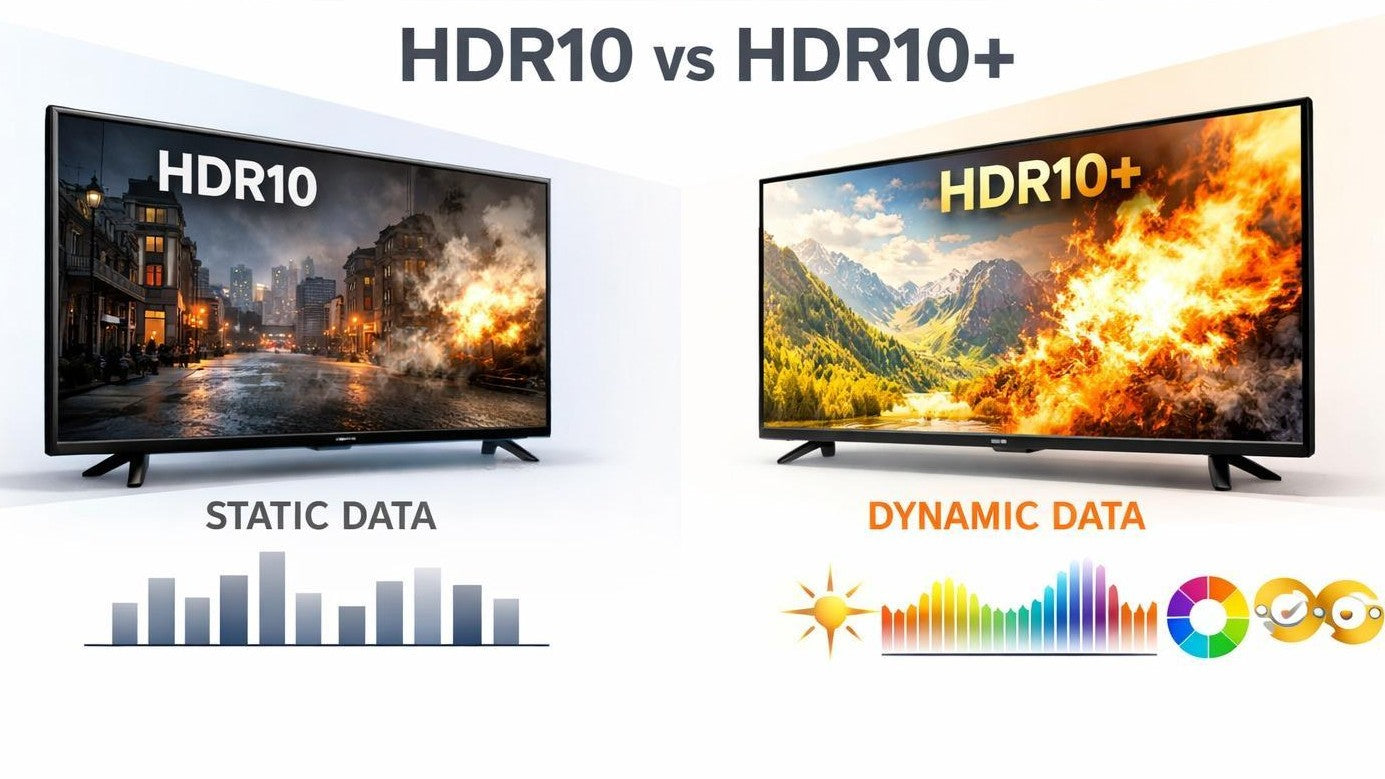
HDR has completely revolutionized modern displays by providing clearer visual details in terms of brightness, color behavior, highlights, and other graphic characters. However, this ability completely relies on a set of metadata working behind the scenes. The HDR metadata is a set of directives that instructs the display on how to accurately interpret visual information.
Meanwhile, this data is not available to every HDR format in the same way. Some HDR formats like HDR10 use a static form of metadata, which isn’t usually available to other HDR types. Static metadata provides a single set of brightness and color behavior, which is applied uniformly across every part of the HDR content.
On the other hand, HDR formats like HDR10+ use dynamic metadata; a type of HDR metadata that allows the parameters to change as the content is displayed in real time. The difference in metadata strongly impacts how each content is optimized. In this article, we’ll explain how static and dynamic metadata work, and why some HDR content feels more lifelike than others.
What Is HDR Metadata in HDR Content?
Before anything is displayed on the monitor, a set of instructions is usually integrated into HDR content, informing the display on how to accurately present the content. This instruction provides directive on tone mapping processes, helping the visual system to adjust visual characters including peak brightness and highlights based on how the original content was produced. This is particularly useful when the display’s features are limited.
The absence of HDR metadata makes it almost impossible for visual systems to accurately replicate the visual details in HDR content. In most cases, users will end up with far less quality and consistent visuals.

Image credit: flatpanelshd
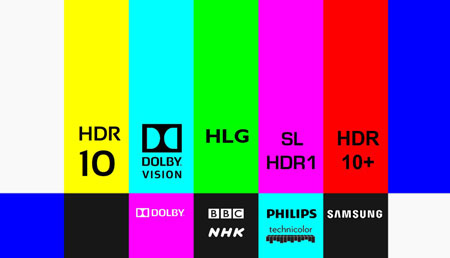
Static Metadata (HDR10)
Static metadata is a constant set of directives with fixed range of brightness and color behavior, created for every part of content. As seen in HDR10, this metadata provides the same guidelines all throughout the content.
Even though the users always end up with a solid HDR experience, the visual system must have made a compromise at one point during display. Since the visual system must apply the same tone mapping throughout playbacks, they can’t optimize for every part of the content, especially in scenarios where the peak brightness reaches dramatic levels.
Dynamic Metadata (HDR10+)
Unlike HDR10, formats like the HDR10+ introduce a different type of metadata. While HDR10 works with static metadata, HDR10+ uses a dynamic method, where the transmitted instruction influences the visual details based on the qualities rendered with the content. This metadata allows the display to change the visual details of every scene, ensuring that each quality is displayed accurately.
Dynamic metadata particularly preserves highlights without washing out details. This type of metadata also improves shadow details, while darker scenes retain depth and clarity. Overall, they adapt to changes in real time, producing more precise visual details and a more consistent visual experience.
What Are The Differences Between HDR10 and HDR10+
Generally, HDR10 and HDR10+ are both designed to display high quality visuals. However, the difference is clear when you compare how both formats handle two similar scenes. This disparity lies in how well each format adapts to changes in visual details during certain moments.
Scene Optimization
The most notable difference is based on how both formats optimize different scenes. On one hand, static metadata cannot influence tone mapping. On the other hand, dynamic metadata allows the visual system to adjust tone mapping based on the scene.
In HDR10 formats, monitors tend to use the same tone mapping settings throughout the content. In other words, image frames and scenes with ultra bright details will only be displayed with the same instruction used by scenes with lower brightness. This also applies to every HDR detail including bit depths, highlights, contrast, and color behavior. Eventually, most scenes will appear over-exposed, while others will lose certain characters.
Meanwhile, HDR10+ format applies a more adaptive process. Since it uses dynamic metadata, the visual system has to change instructions for certain scenes with different levels of HDR characters. Practically, this format provides a more consistent content performance and visual experience.
Highlight And Shadow Detail
Another prominent difference between HDR10 and HDR10+ is the level at which they handle extreme cases of luminance and dim scenes. Considering that HDR10+ uses dynamic metadata, they preserve more detail in any visual condition.
Meanwhile, HDR10 does not have the luxury of preserving details in any condition. Since the set of instructions are static, the visual system is only limited to a single brightness guideline for the entire part of the content.
Unfortunately, they can result in highlight clipping… a situation where the brightest part of a pixel loses its fine details. Sometimes, these types of content may appear washed out or suffer crushed black in case of extremely dark scenes.
HDR10+ gives a solution to this problem by adjusting how each scene is meant to be displayed. Image frames with brighter scenes remain bright without losing any form of detail. Same applies for darker scenes, where fine details are optimized enough to maintain depth and clarity.
Content Consistency
The overall image feel during display is one of the best parameters that can be used to compare HDR10 and HDR10+. The appearance of consistent visual details across scenes is an indication of dynamic metadata.
For static metadata, usually found in HDR10, the visual system is permanently locked into one stable brightness profile. Whenever the content turns to a different level of visual detail, the monitor automatically applies the same profile by using the same static instruction.
As for HDR10+, the visual system can keep the brightness levels more stable and appropriate for every part of the content. In this case, the overall viewing experience appears more natural and under control.
Hardware And Ecosystem Support
Beyond screen performance, compatibility, marketability, and availability is yet another important difference between HDR10 and HDR10+. In today’s market, HDR10 is highly supported across many visual systems.
The HDR10 is the base level for HDR formats, and is supported by default. It is the benchmark used by monitor industries in streaming services, Blu-ray discs, and gaming platforms.
However, HDR10+ is quite limited and hard to access when compared to HDR10. Despite offering better visual performance with its dynamic metadata, the format needs its content to be mastered in HDR10+. Even though it’s beginning to take over the monitor industry, it’s still not as available as HDR10.

Image credit: professionalreview
Why Dynamic Metadata Can Improve HDR Experience
The biggest advantage of HDR10+ is the real impact it has on what you actually see on your screen. While every scene and image frame is displayed, HDR10+ updates the visual conditions by adjusting the characters in real time.
Whenever explosions and sunlight with higher peak brightness are displayed, dynamic metadata protects the details from being washed out. In dim scenes with night shots, they help maintain bit depth and shadow details. In case of high contrast transitions, where scenes move from a very bright exterior to a very dim interior, dynamic metadata avoids the sudden jump in highlight quality. This gives the visuals a more consistent and natural performance.
Conclusion
In summary, the most notable difference between HDR10 and HDR 10+ is down to the sets of instructions delivered by its metadata. HDR10 uses a static type of metadata that applies just one set of instructions for every visual detail across the entire content.
As for HDR10+, they use a dynamic type of metadata, which updates the set of instructions depending on the visual details of the scene. This type of metadata is so complex that it allows scene-by-scene tone mapping, to preserve the video characters and maintain overall consistency. This is the reason it replicates more accurate HDR content irrespective of the scene.
Share:
What Is Tone Mapping? Why HDR Look Different on Every Monitor
Why There Is No HDMI Signal From Your Device?