

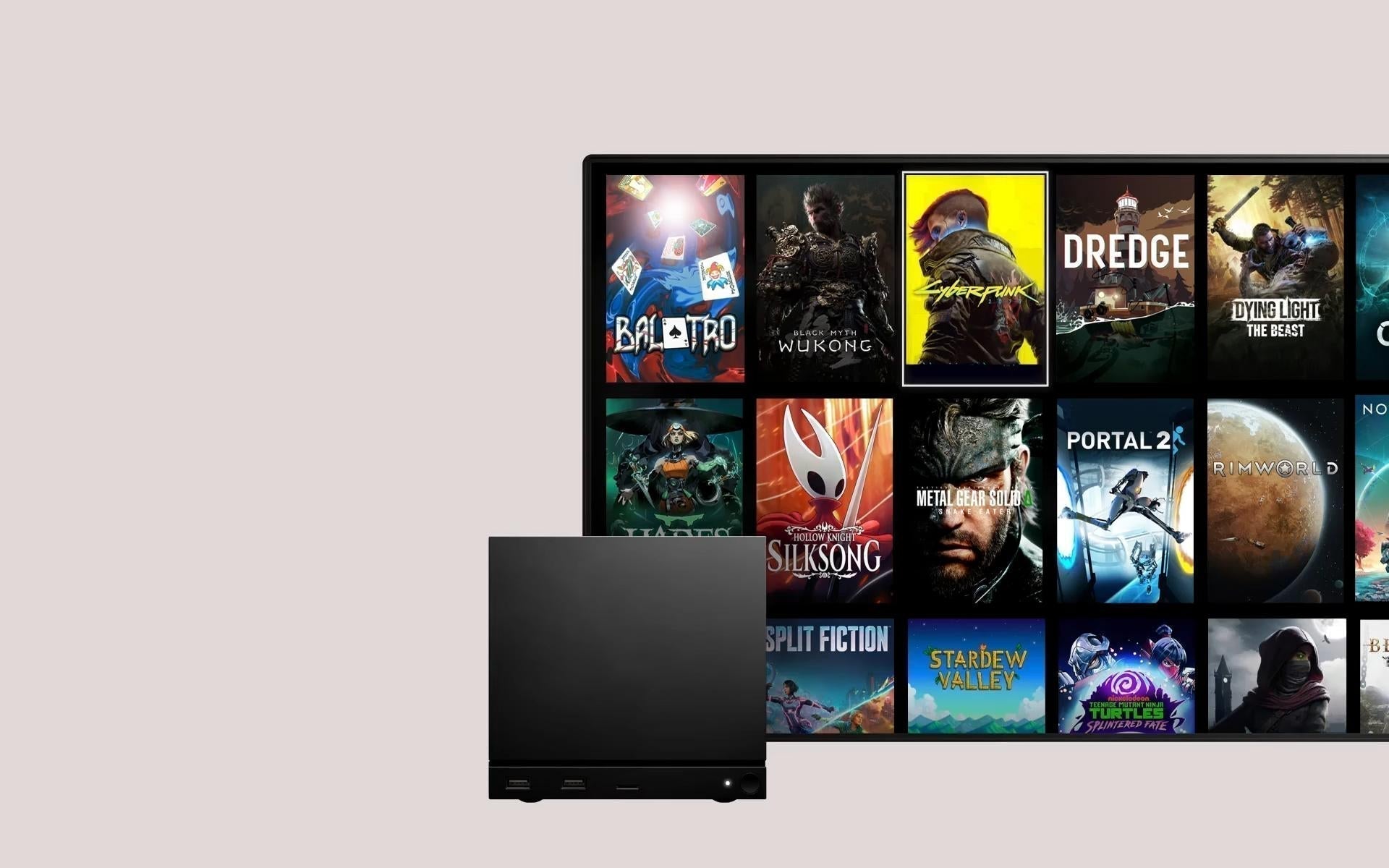
Valve is going all in on the hardware market, and their latest “innovation” is the PC-console hybrid, the Steam Machine. If you’ve been OOTL, the Steam Machine is Valve’s upcoming hardware, which is an interesting proposition, bringing the PC gaming experience to a more console-friendly audience.
Instead of being hunched over your desk/monitor setup, you can game “freely”, on the couch, while still enjoying your vast backlog of Steam games you’ve never gotten around to.
Today, we’re checking out everything we know so far about the soon-to-release Steam Machine, breaking down what it offers, who the system is for, and whether it’ll truly be worth your hard-earned cash.
Steam Machine Potential Release Date

Valve announced their upcoming Steam Hardware in Novemeber 2025, with an announcement video showcasing the shiny new Steam Machine, the upgraded & brand-new Steam Controller, and the fancy VR Steam Frame headset.
In the video, all they really said was that all of this would be released in early 2026.
Realistically speaking, this should be within Q1 of 2026, which gives us till the tail end of March 2026.
What We Know About the Steam Machine So Far
The Steam Machine Spec Sheet

Probably the most important thing to know about the Steam Machine is the specs; a console-PC hybrid will only be as good as its specs, determining whether it thrives or is left out in the cold for gamers.
The good news is the Steam Machine is a pretty powerful performer, and Valve is claiming it’s at least 6x more powerful than the Steam Deck. In fact, one of the main reasons the Steam Machine is even a thing is because Valve realized that many Steam Deck owners were docking & playing with a Steam Deck external monitor.
In that regard, the Steam Machine was the obvious next step.
Here are all the specs we know the Steam Machine has to get a better look at what the Machine is packin':
- CPU: Semi-custom AMD Zen 4 6C / 12T (up to 4.8GHz, 30W TDP)
- GPU: Semi-custom AMD RDNA3 28CUs (2.45GHz max sustained clock speed, 110W TDP)
- RAM: 16GB DDR5 + 8GB GDDR6 VRAM
- Storage: 512GB/2TB SSD
- Wi-Fi: 2x2 Wi-Fi 6E
With these specs, the Steam Machine is a pretty solid performer and is close to a mid-range PC. In fact, according to Valve Engineer Yazan Aldehayyat, the Steam Machine “is equal or better than 70% of what people have at home.”
This was revealed in an interview with Adam Savage’s Tested and is based on Steam’s Hardware Survey, which gives you a pretty good idea of what we can expect.
In more practical terms, we know the Steam Machine is capable of 4K resolutions at 60FPS, 4K with FSR, and stable 1080p performance.
For some, a pretty significant upgrade, but for others, it’s just not good enough. But more on that later.
Operating System

Similar to the Steam Deck, the Steam Machine will run on Steam’s Linux-based operating system, SteamOS.
If this is your first foray into Steam’s hardware, SteamOS is simply a streamlined UI experience where everything’s centered around gaming; no finagling with menus to get Elden Ring up and running here.
SteamOS does have its flaws, but for the most part, it should make the “PC gaming” experience a lot more approachable for players who’ve never gamed on a PC.
Not to mention Steam’s now got things figured out with game compatibility; using an additional Proton layer to force compatibility, so even if the game isn’t “Verified” for the Steam Machine, it is possible to play a substantial amount of games in your library.
What Makes it Special?

Probably the most important aspect that makes the Steam Machine “special” is its size. Measuring in at roughly a 6-inch cube shape, the Steam Machine gets you the power of a powerful, albeit mid-range PC, in a fraction of the size of the usual PC towers.
This makes it a great option to just slot in next to your TV for couch gaming, or neatly tucked away under your desk & connected to a gaming monitor if you prefer a more minimal, yet uncompromising PC.
This size and petiteness of the Steam Machine is a major draw for many gamers (us included).
To top it all off, the Steam Machine has customizable face plates that you can basically put anything on (if you’ve got a 3D printer on hand, anyway). Valve will probably sell their own face plates, and we expect 3rd party vendors to start making some sick custom face plates too, adding a fantastic layer of customizability.
But at its core, the potential “biggest” thing about the Steam Machine is that, while it’s a PC-console hybrid, it’s still a PC. Which means you can use it for things other than gaming, like installing your own software and even another OS (Windows most likely).
Steam Machine vs Other Gaming Consoles

If we compare the Steam Machine to other ‘gaming consoles’, it’s really just about makin’ PC gaming a whole lot easier to get into; like how it is with traditional consoles like the PS5 and Xbox Series X/S. Compared to those, though, does the Steam Machine stack up?
Realistically, quite well, actually.
According to the OGs of testing hardware and new gadgets, Digital Foundry, when compared to other consoles, the Steam Machine’s performance is somewhere between the Xbox Series S and PS5.
Theoretically, this means we can expect a similar level of graphical fidelity, performance, and gaming experience on the Steam Machine as we do on the current-gen consoles.
Why the Steam Machine Might Not Be All It’s Cracked Up to Be?
Game Compatibility (& Reliance on Proton Layers)

Steam being Steam, you basically have the entire catalogue of Valve’s renowned marketplace at your disposal. But, there’s a twist; the Steam Machine runs SteamOS, a Linux-based operating system.
But the problem is that most of Steam’s catalogue is mainly available on Windows. This brings a conundrum (which has mostly been ironed out, to be fair) where not every game works or runs well on the OS.
This applies similarly to the upcoming Steam Machine; only if the game has passed Valve’s “Verified” program can you be sure the game will run perfectly out of the box.
This doesn’t mean you can’t play games that aren’t supported, but it does mean you’ll need to additionally set your games up with the Proton compatibility layer.
We expect supported games for the Steam Machine to grow once it releases, but you may have to wait for support if the game doesn’t work on the “GabeCube” just yet.
Powerful Specs, but Only For Now
Based on our research, the Steam Machine does impress in terms of specs, especially considering the size. However, at best, the Steam Machine is a mid-range PC, and only barely matches up to current-gen consoles (which are already on their last legs).
While it’s enough of a powerhouse to handle most games right now, it may be outdated quickly or not as powerful if you built a custom PC right now or in the near future.
It’ll still run most games at a respectable graphic quality/frame rate, but not to what more “hardcore” enthusiasts may expect. It’ll still look great on a 144Hz gaming monitor, though!
The Pricing Dilemma
Quite possibly the biggest hurdle with the Steam Machine is the hotly debated price tag.
From everything we know so far, the Steam Machine looks to be on the level of a mid-range PC and current-gen consoles. But, based on the info since the announcement, it may not be priced like a console even though it’s positioned as one.
According to Linus from Linus Tech Tips, who had a chance to get hands-on with the new Steam hardware, he mentioned that “while it will be very competitively priced with a PC, it will be priced like a PC” instead of being priced like a console.
This is a major drawback since it means it could be even more expensive than a PS5, even though it won’t have that much more power, performance, or “exclusive features”. For context, right now, a PS5 Pro goes up to $799, which means that a Steam Machine could be well above that price point, possibly reaching up to $1000.
We’ll only know the real price when Valve announces it, but for now, it’s a big ask for something, while having the versatility of a PC & a sleek, trim form factor, not having as much of the raw power you expect at that high a price point.
Who Is the Steam Machine For? (And Who Should Skip It)

Here’s a quick look at the kind of gamer the Steam Machine is right (and wrong) for based on what we know:
Who should get a Steam Machine:
- Console-first gamers who want to try out PC gaming
- Gamers who want a more couch-friendly PC gaming experience
- Steam Deck/PC handheld gamers who want a more powerful, dock-style setup
- PC gamers with outdated systems & looking for a streamlined PC gaming experience
Who should avoid the Steam Machine:
- PC enthusiasts who already own high-end rigs
- Gamers who want maximum possible performance & graphical fidelity
- Console gamers not comfortable with troubleshooting compatibility issues
This list is far more extensive, but it’s a general view of who can make the best out of the Steam Machine, and who should probably pass on it.
Conclusion: Is the Steam Machine Worth It?
Realistically, the Steam Machine isn’t going to be the most powerful PC you’ve ever seen; but instead, it offers a streamlined, simple, and mini PC-console hybrid that just works (for the most part).
It really is for more “casual” gamers who want PC gaming, but just not with the intricacies of traditional PC setups.
But if you’ve already got a hardcore rig with a high-end GPU that isn’t due for an upgrade anytime soon, and just can’t give up crisp, high-resolution fidelity at higher refresh rates, then this simply isn’t for you.
As a whole, though, depending on how the Steam Machine is actually priced, it could be a revolutionary start to making PC gaming accessible & an actual “competitor” to traditional console platforms.
Share:
Steam Deck Game Compatibility: What Can It Really Play?
CES 2026 Roundup: The Gaming Hardware That Actually Matters